“I need it! It’s got all the capabilities of [existing tools] with more potential.”
- Branch manager
As one of the leading global distributors, with sales operations spanning hundreds of branches, the organization operates in an environment where speed, accuracy, and consistency directly impact growth. As quoting volume and complexity increased, leadership recognized that fragmented, manual workflows would not scale. Rather than waiting for inefficiencies to constrain growth or degrade the customer experience, leadership began exploring how AI could modernize the sales process.
While sales teams managed product information and customer relationships day to day, the quoting process placed excessive cognitive and operational load on individual reps. Critical steps depended on memory and manual coordination across systems, slowing execution and limiting throughput as volumes grew.
Leadership identified a clear opportunity to use AI to reduce manual effort and operational friction, allowing teams to focus on higher-value work. Several core challenges emerged.
Manual, Time-Intensive Quoting
Even straightforward quotes required at least 10 minutes of manual entry. At scale, high-volume and repeat quoting significantly limited sales throughput.
Limited Support for Real-World Complexity
Existing sales tools simply could not support construction takeoffs and plumbing schedule uploads, leaving a critical gap in potentially automating the entire quoting process.
Insufficient Product & Customer Context and Restrictive Order Format
Product matching did not consistently reflect branch-level inventory or customer purchasing history, leading to generic recommendations. Managing customers with multiple ship-to locations added further friction. The format of requests supported by existing tools was incredibly limiting.
Disconnected Systems and Manual Handoffs
Email-to-quote workflows required heavy human intervention, even for predictable orders. Partial ERP integration drove manual entry, increased error risk, and reduced visibility when converting estimates into sales orders.
Before Distro, the organization utilized a legacy OCR-based solution for basic document extraction, but it lacked the intelligence and scalability required for enterprise sales operations. Seeking to modernize its quoting and sales workflow, the organization subsequently onboarded a newer quoting tool that improved surface-level workflows but quickly fell short, particularly when handling complex takeoffs and plumbing schedule uploads
After being introduced to Distro and seeing in-depth demonstrations of the platform, the leadership team quickly decided to replace their existing sales automation vendors. They immediately recognized that what had been missing from prior solutions was the ability to move beyond fragmented point tools to a complete, agentic sales platform purpose-built for complex distribution environments.
Key factors that set Distro apart:
Complex Document Accuracy
Reliable processing of complex takeoffs and construction documents that other solutions could not consistently support.
Native Eclipse ERP Integration
Deep, native integration with Eclipse ERP, eliminating manual handoffs and duplicate data entry.
Distro Agent, AI Sales Assistant
Distro Agent, an AI sales assistant embedded directly into the quoting workflow and available as a standalone tool for both counter and outside sales teams.
Industry-Proven HVAC & Plumbing Expertise
Proven expertise in the HVAC and plumbing industry, supported by validation from industry organizations.
Single Unified Sales Platform
A unified platform approach, replacing multiple point tools with a single intelligent sales system.
White-Glove Strategic Support
White-glove, ongoing support, positioning Distro not just as a vendor but as a long-term strategic partner.
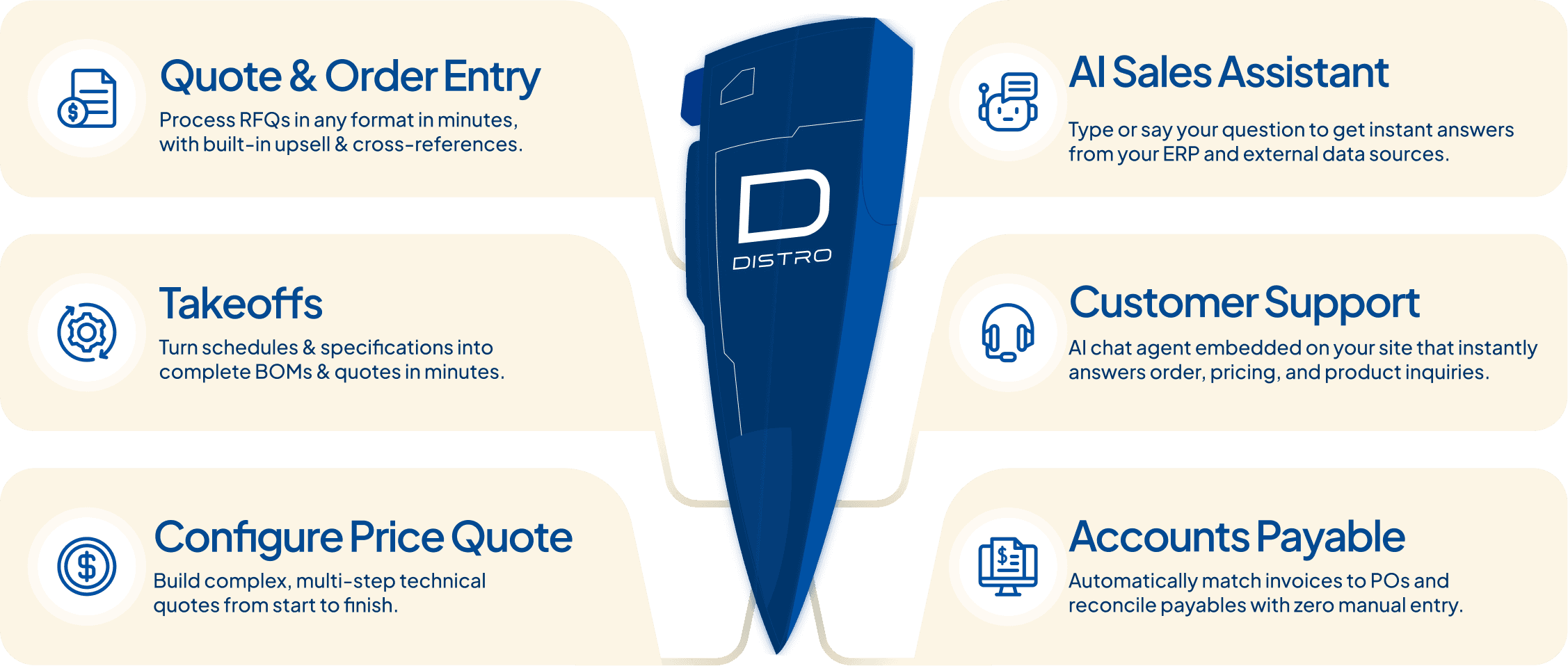
Once Distro launched, adoption was immediate and enthusiastic, as teams quickly embraced the platform and began using it naturally in their day-to-day work while seeing real impact from day one.
Time to quote efficiency increased by 90%, eliminating manual entry bottlenecks and friction.
Teams successfully processed highly complex quotes at scale, handling approximately 1,400 lines daily, with individual quotes frequently containing 100+ line items.
AI-driven matching improved continuously, learning from customer purchasing behavior and inventory patterns with each interaction.
Branch-level inventory awareness and customer-specific learning significantly increased product match accuracy.
By replacing fragmented tools with a unified sales AI platform, this global distributor gave its teams something they had not felt in years: control. What used to be a stressful, manual quoting process became a smoother, more predictable experience where reps could focus on customers instead of wrestling with systems.
The shift was felt immediately. Quoting efficiency increased by 90%, freeing sales teams to respond faster and with more confidence. Complex requests that previously caused frustration were processed effortlessly. Distro Agent delivered instant product and inventory answers, helping reps show up as trusted advisors rather than order takers.
The transformation went beyond speed. Teams felt more confident, more supported, and more connected to their customers, creating a stronger and more resilient sales organization ready for the future.
Further decrease time to quote across high-volume and complex orders.
Increase quote throughput per rep without adding headcount.
Improve consistency and accuracy across branches by reducing dependence on tribal knowledge.
Accelerate onboarding by giving new sales team members immediate access to institutional knowledge.
By standardizing intelligence at the point of execution, the organization transformed quoting from a manual bottleneck into a scalable advantage, enabling consistent performance across hundreds of branches while supporting growth without increasing operational complexity.